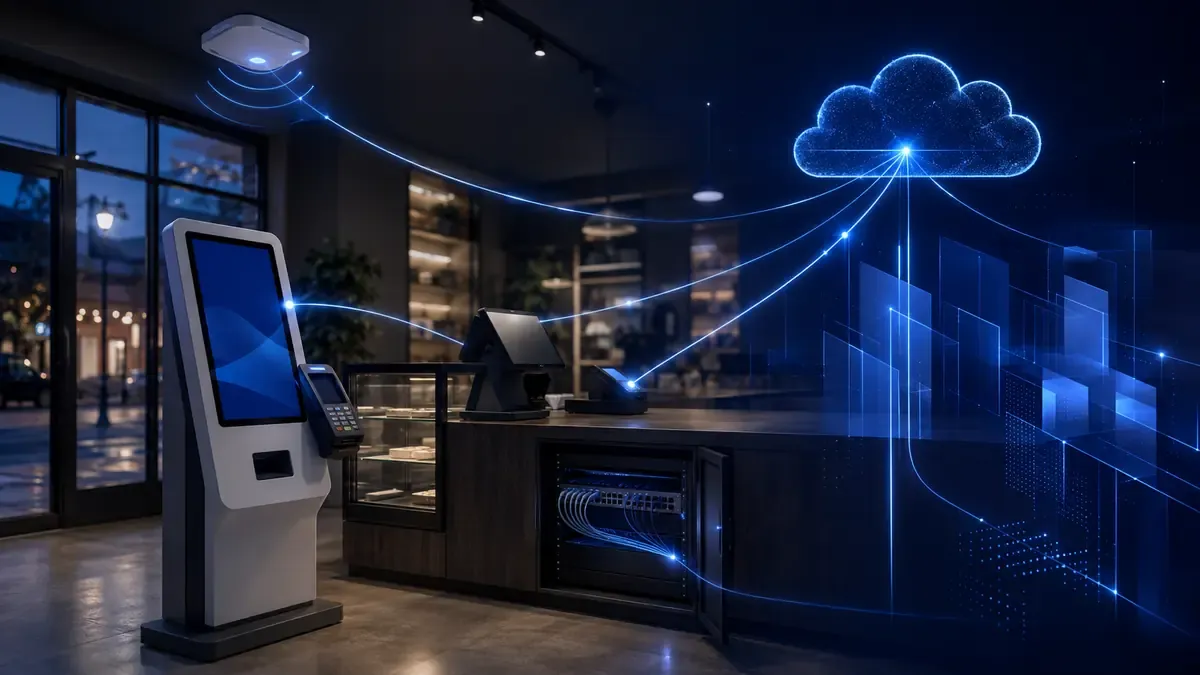
Most IT support and managed service offerings were built with an online or office-based business in mind: cloud accounts, laptops, a handful of SaaS tools, maybe a help desk ticket here and there. That model works well for a business that lives entirely on a screen. It works much less well for a business that lives on a floor — a laundromat, a car wash, an auto shop, a boutique hotel, a pharmacy, a parking facility.
The difference isn't really about the technology being more advanced in one case. It's about where the technology has to survive.
What's different about a physical location
The network has to survive a building, not just a router. An online business might run on a single office connection and a cloud dashboard. A brick-and-mortar location has a network that has to reach a POS terminal at the counter, a kiosk near the entrance, a security camera in the back, and Wi-Fi that customers actually use — often across a building that wasn't designed with any of this in mind.
Hardware fails physically, not just digitally. A payment terminal can get knocked off a counter. A kiosk touchscreen sits in direct sunlight all day. A network switch lives in a closet that gets warm in summer. None of this happens to a purely cloud-based business, and it changes what "IT support" needs to cover — physical resilience matters as much as software configuration.
Uptime is customer-facing in real time. If an online business's checkout page goes down for ten minutes, that's a bad ten minutes. If a car wash's payment kiosk goes down for ten minutes, there's a physical line of cars behind it and no way to quietly retry later. The tolerance for downtime is lower because the customer is standing right there.
On-site presence is occasionally unavoidable. Most issues can and should be solved remotely — that's the more efficient default for both sides. But cabling, hardware failures, and physical installs sometimes need someone standing in the building. An online business almost never needs this at all.
Where the two actually merge
Here's the part that's easy to miss: brick-and-mortar businesses aren't purely physical anymore, and that's exactly where they get underserved by traditional IT support.
A modern storefront still runs on cloud software — the POS is often cloud-based, bookings happen online before the customer ever walks in, payment processing runs through the same online rails as any e-commerce business, and reporting lives in a dashboard somewhere. The physical location is really a front end sitting on top of the same online infrastructure everyone else uses.
This is the actual gap: a traditional MSP that only thinks in terms of laptops and cloud accounts misses the physical layer entirely. A software vendor that only thinks in terms of the app misses the fact that it's running on hardware sitting in a building with its own network, power, and foot traffic. Neither one, on their own, is looking at the whole picture.
Why this matters for how support should actually work
A brick-and-mortar business needs IT support that treats the physical location and the online systems running on top of it as one connected environment, not two separate problems handled by two separate vendors. That means:
- Network and hardware support that accounts for the realities of a physical space — foot traffic, equipment wear, and layout constraints an office network never has to deal with
- Software and systems (POS, booking, payment) treated as part of the same support relationship as the network they run on, not a separate ticket to a separate vendor
- A support model that defaults to remote, since most problems are solvable that way, but doesn't pretend on-site needs never come up
- Kiosk and customer-facing hardware supported with the understanding that it's public-facing, physically exposed, and needs to just work when a customer walks up to it
The takeaway
The old split — "IT support" for the office and "software support" for the app — doesn't really fit a business that's part physical storefront and part cloud-based system. The businesses that get the best support are the ones whose IT vendor understands both halves as one environment, rather than treating the physical location as an afterthought to a software-first support model, or the software as an afterthought to a network-first one.