The White-Collar Blind Spot
Much of the conversation about the future of work focuses on AI for office tasks: generating content, analyzing information, writing code, and automating digital workflows.
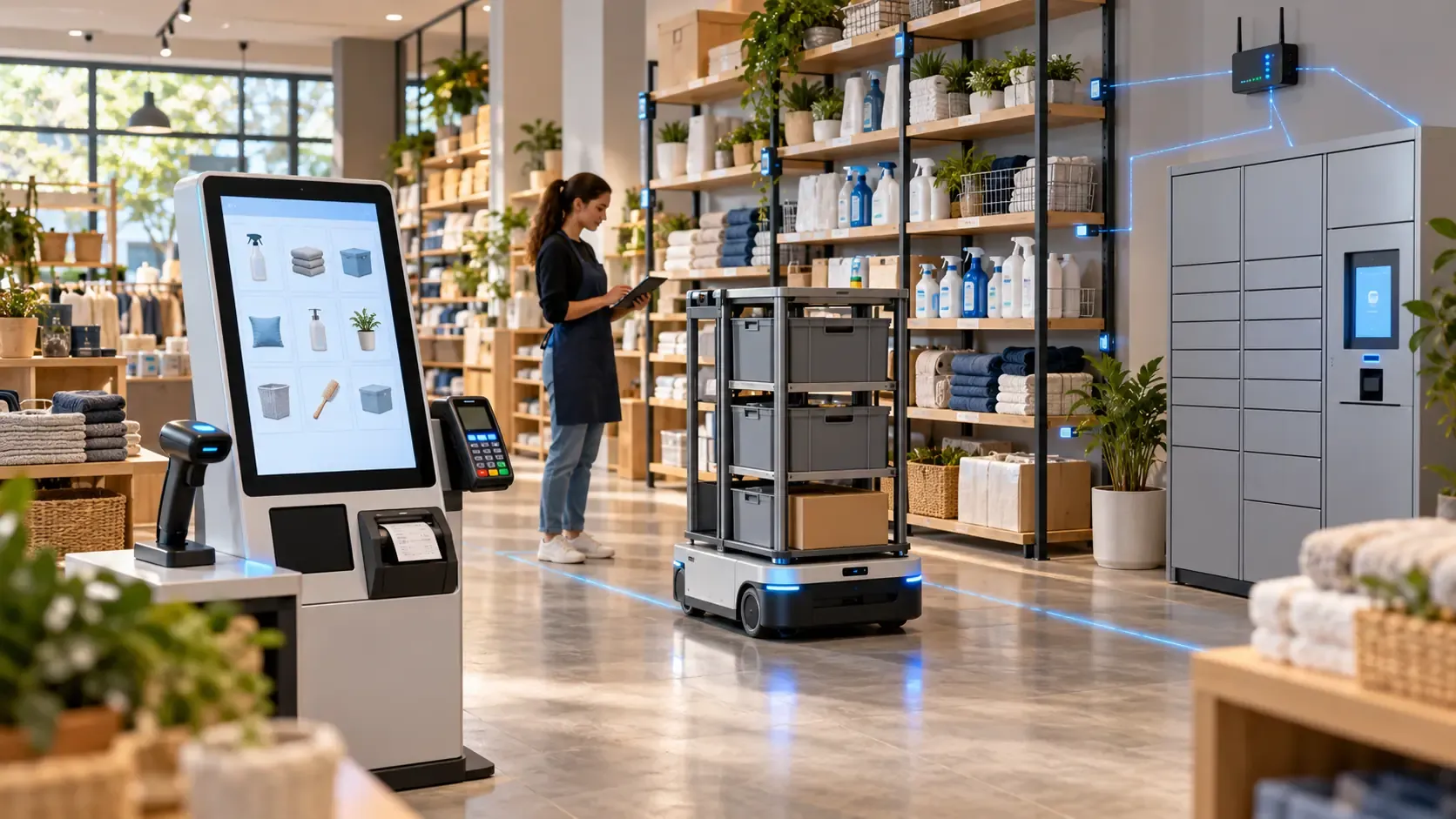
That focus can overlook the work happening inside brick-and-mortar businesses, shops, and other physical businesses. Customers still need to order and pay. Products need to be prepared and handed over. Equipment needs to be monitored, and access needs to be controlled.
We see AI as one slice of a broader automation opportunity. Kiosks, robotics, sensors, and controllers can automate tasks that extend beyond a screen.
Already Available in China
Physical automation does not always require inventing new hardware. Chinese suppliers already offer kiosks, sensors, relay controllers, and task-specific machines that can form part of a business system.
Availability is only the starting point. Equipment still needs to suit the premises, support the required interfaces, and work with the operator’s software and processes.
At Fieldzora, we see opportunity in closing that gap: selecting suitable hardware and connecting it to useful operational software.
AI Alone Doesn’t Deliver a Working System
Adding AI to software doesn’t automatically make it more useful to a business. Its value depends on how well it fits the operation, connects with existing systems, and reduces manual work.
Specialized expertise matters when it turns those capabilities into reliable outcomes.
At Fieldzora, we combine software expertise with hardware testing, physical deployment, and local accountability. We focus on making the complete system work—from the customer interface to payments, connected devices, and staff workflows.
Physical Automation Needs Integration
A kiosk can take orders and payments. A robot can perform specific physical tasks. IoT devices can monitor conditions and trigger actions.
Each automates part of the work. Turning those capabilities into a useful business system requires connecting hardware, software, payments, inventory, and staff workflows.
Our approach starts with understanding the operation: assessing the premises, testing compatible hardware, planning for exceptions, and confirming that the system works where it will actually be used.
Global Sourcing, Local Accountability
Hardware can be imported. Software development can be distributed across countries. AI can assist with implementation.
We see the systems integrator’s role as coordinating those resources and taking responsibility for the deployed system. That includes selecting compatible equipment, validating integrations, coordinating installation, and establishing a workable support plan.
Physical presence alone doesn’t guarantee value. The value comes from resolving integration problems and delivering an outcome the operator can rely on.
Automation Must Earn Its Place
For a business operator, automation needs to reduce repetitive work, increase capacity, or improve service enough to justify its purchase and ongoing costs.
That means examining the whole workflow. A kiosk that takes orders faster offers limited value if preparation is already the bottleneck. An automated device that requires constant intervention may simply move work elsewhere.
We focus on clearly defined tasks and how they fit the surrounding operation. Staff handoffs, payment handling, order routing, and recovery when something fails all matter.
Our Direction at Fieldzora
We’re building toward physical automation that connects globally sourced hardware with custom software and local systems integration.
Self-service kiosks are our starting point. Selected IoT and robotics integrations are part of our longer-term direction, building on the same principle: make individual devices and systems work together to reduce manual work.
AI is part of our toolkit. The outcome we aim to deliver is a working system that earns its place in the business.