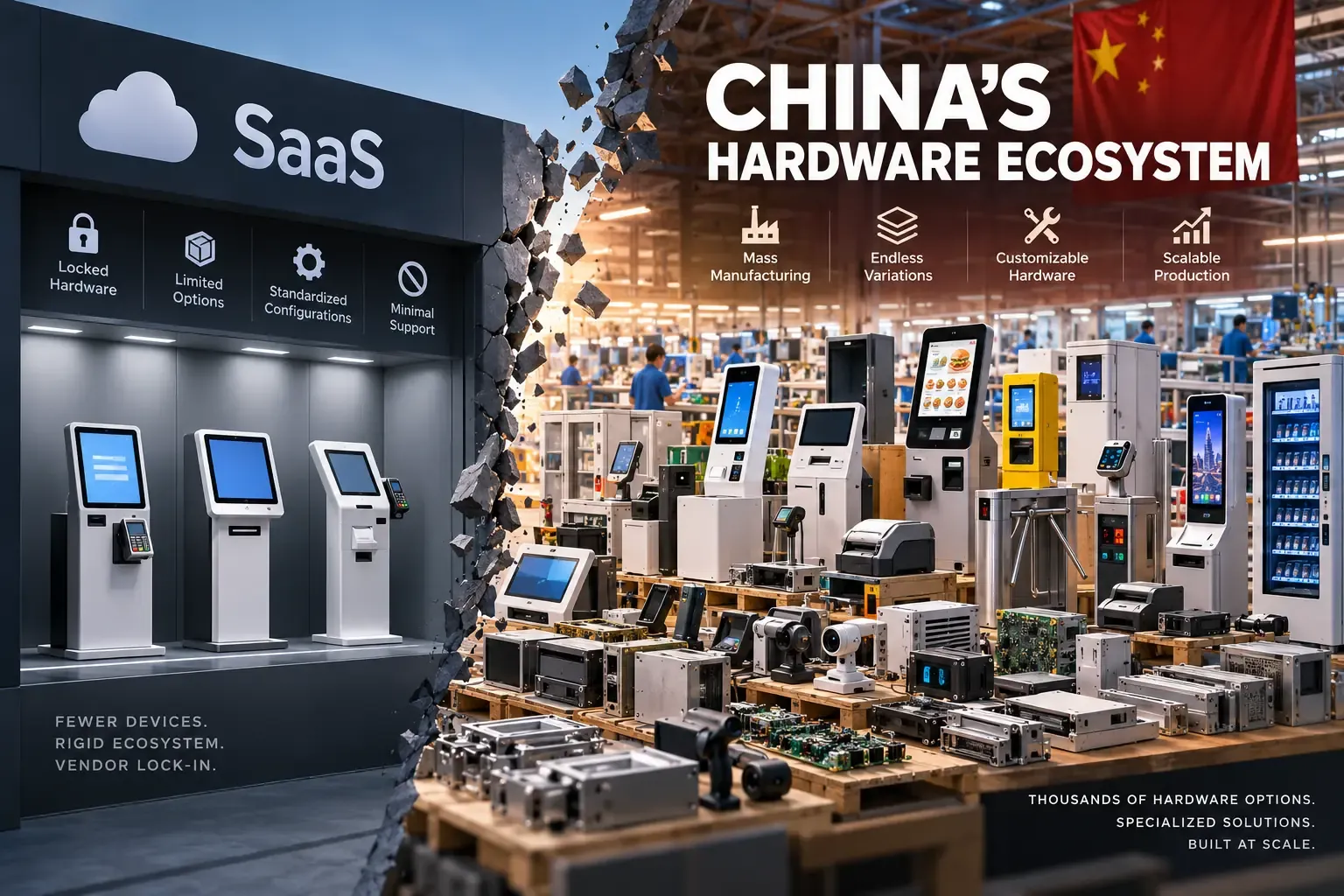
The next wave of business automation won't be won by software alone. China's vast hardware manufacturing ecosystem is challenging the competitive leverage of traditional SaaS providers by making specialized, customizable hardware increasingly accessible at scale.
For the past decade, Software as a Service (SaaS) has dominated business technology. Its appeal is straightforward: centralized software, recurring subscriptions, standardized features, and minimal physical infrastructure.
But as businesses increasingly adopt physical automation, the traditional SaaS model faces a structural disadvantage.
SaaS companies are built to avoid operational complexity. Physical automation requires embracing it.
China's enormous hardware manufacturing ecosystem is creating opportunities for systems integrators willing to handle that complexity.
SaaS Was Designed to Eliminate Operational Complexity
The traditional SaaS business model is built around scalability.
Develop software once, distribute it to thousands of customers, and collect recurring subscription revenue without needing technicians at every customer location.
This model works exceptionally well for accounting platforms, CRM systems, scheduling software, and other primarily digital workflows.
However, it creates a different set of incentives when SaaS companies enter the physical automation market.
To preserve their margins and scalability, many providers deliberately limit the complexity of their hardware offerings.
They prefer:
- Standardized hardware configurations that are easy to ship and replace.
- Locked-down software ecosystems with limited third-party integration.
- Restricted peripheral compatibility to reduce support requirements.
- Cloud-managed systems that minimize on-site technical intervention.
- Subscription-based functionality instead of extensive customer-specific modifications.
The objective is to make deployment as predictable and repeatable as possible.
Ideally, no technician ever needs to show up.
That is an attractive business model for the SaaS provider. But it doesn't necessarily deliver the best automation solution for the customer.
Limited Hardware Variety Means Limited Automation
One of the most overlooked weaknesses of SaaS-based physical automation is the limited variety of hardware available to customers.
Consider self-service kiosks.
Many SaaS kiosk providers offer only a handful of standardized configurations. These may include a countertop kiosk, a freestanding touchscreen, or a wall-mounted ordering terminal.
The software is designed around those predefined devices, typically supporting a limited combination of payment terminals, printers, and scanners.
This simplifies deployment and customer support, but it also restricts what businesses can automate.
China's hardware manufacturing ecosystem offers a much broader range of possibilities, including card dispensers, RFID readers, access-control components, weighing systems, sensors, automated drawers, and custom enclosures.
A business may need an unusual combination of these components to automate a specific operation.
Yet a SaaS provider may decline to support that configuration because it falls outside its standardized product offering.
Hardware variety isn't just about appearance or form factor. It determines which physical processes can actually be automated.
When hardware choices are restricted, automation possibilities are restricted with them.
Does the Kiosk Actually Eliminate Work, or Just Move It Somewhere Else?
Another overlooked question is whether standardized self-service kiosks actually eliminate operational work.
A kiosk may replace the initial customer interaction, but what happens when customers struggle to navigate the interface, cannot find an option, encounter payment difficulties, or need assistance completing their transactions?
If employees must repeatedly intervene, the kiosk hasn't fully automated the process.
It has simply transferred part of the workload from a cashier to another employee providing customer support.
In some environments, customers may barely notice the kiosk or may continue approaching staff out of habit.
Businesses can end up paying for both the kiosk subscription and the employees required to assist customers.
Replacing a cashier interface is not the same as eliminating the underlying operational workload.
This distinction becomes especially important when the kiosk software is too rigid to accommodate real customer behavior.
Perhaps the ordering process requires too many steps. Perhaps customers need assistance with unusual requests. Perhaps the business still needs an employee to manually coordinate fulfillment.
A standardized SaaS kiosk may successfully digitize one part of the transaction without meaningfully automating the entire workflow.
That doesn't mean kiosks are ineffective. Well-designed kiosks can reduce repetitive work, improve order accuracy, and allow employees to focus on other responsibilities.
But automation should be measured by the actual reduction in manual intervention, not simply by the number of touchscreens installed.
China's Hardware Ecosystem Changes the Economics
China has spent decades building an extensive electronics and manufacturing supply chain.
Today, businesses can source an extraordinary range of components and equipment, including:
- Touchscreen displays, industrial PCs, and kiosk enclosures.
- Barcode scanners, NFC readers, and RFID modules.
- Card dispensers, thermal printers, and payment terminal mounts.
- Motors, relays, sensors, and electronic controllers.
- Custom metal fabrication, PCB manufacturing, and wiring assemblies.
- Specialized equipment for hospitality, retail, logistics, and industrial automation.
Many of these components are available independently, without requiring customers to purchase a complete proprietary system.
That changes the economics of building custom automation.
Instead of designing every component from scratch, a systems integrator can combine existing hardware with custom software and purpose-built mechanical assemblies.
A business might need only a touchscreen, industrial PC, USB scanner, and electronic relay to automate a particular workflow.
The components already exist.
The challenge is selecting, integrating, programming, testing, and supporting them.
The value is increasingly shifting from owning the hardware to knowing how to make different hardware work together.
Hardware Fragmentation Is Challenging the SaaS Hardware Moat
For years, SaaS companies entering the physical automation market have relied on tightly controlled hardware ecosystems.
By limiting customers to a handful of approved kiosk models, payment terminals, printers, and peripherals, these providers can simplify deployment, reduce technical support requirements, and maintain control over their subscription ecosystems.
But China's manufacturing ecosystem introduces a very different competitive dynamic:
Hardware fragmentation at an enormous scale.
Across China's electronics and manufacturing supply chains, factories produce an extraordinary variety of specialized components, devices, and mechanical configurations.
A kiosk doesn't have to be limited to a touchscreen, receipt printer, and payment terminal.
It can incorporate card dispensers, passport scanners, RFID readers, electronic locks, weighing scales, sensors, automated compartments, or specialized machinery.
Even the enclosure itself can be customized for different environments, workflows, and physical requirements.
More importantly, Chinese factories can manufacture many of these variations at commercial scale.
Instead of forcing every customer into a handful of predefined hardware configurations, manufacturers can modify existing designs, combine components from different suppliers, and produce specialized equipment in batches.
This creates an increasingly fragmented hardware landscape, with countless combinations of components and form factors available to systems integrators.
What looks like fragmentation to a SaaS company can look like opportunity to a systems integrator.
Why China's Manufacturing Ecosystem Threatens SaaS Hardware Leverage
Traditional SaaS hardware providers benefit from controlling which devices customers can use.
A closed ecosystem encourages customers to remain with the same provider for software updates, compatible peripherals, hardware replacements, and ongoing subscriptions.
But that leverage weakens when businesses can source alternative hardware from an extensive manufacturing ecosystem.
A systems integrator can select a commercially available enclosure, install an industrial PC, connect peripherals from multiple manufacturers, and develop software around the customer's actual workflow.
The customer no longer necessarily needs to purchase the SaaS provider's proprietary hardware bundle.
Nor does every new automation requirement need to wait for the provider's product roadmap.
China's hardware variety also creates competitive pressure between manufacturers themselves, potentially reducing the cost of specialized components and custom fabrication.
The result is a different form of competition.
Rather than competing on who controls the most restrictive hardware ecosystem, providers compete on who can deliver the most effective operational solution.
Standardization Versus Specialization
SaaS providers have an incentive to minimize hardware variations because every additional configuration introduces testing, compatibility, maintenance, and support responsibilities.
Chinese manufacturers have a different incentive: produce equipment that meets customer demand, including specialized configurations when order volumes and economics justify them.
These two models are increasingly pulling in opposite directions.
SaaS scales by minimizing hardware variations. China's manufacturing ecosystem can scale by producing an enormous variety of hardware variations.
Systems integrators sit between these worlds, turning fragmented hardware options into functioning automation solutions.
Of course, fragmentation introduces challenges of its own, including inconsistent documentation, firmware compatibility, quality control, and replacement-part availability.
But solving those problems is precisely where technical integration expertise becomes valuable.
The competitive advantage shifts from restricting hardware choices to successfully integrating them.
China's manufacturing ecosystem doesn't automatically eliminate SaaS. Large SaaS providers can also embrace modular hardware and open integrations.
However, it challenges the long-term pricing power of companies whose hardware leverage depends primarily on keeping customers locked into a small selection of approved devices.
When thousands of specialized hardware options become commercially accessible, a rigid SaaS ecosystem can begin to look less like a convenience and more like a limitation.
Why Systems Integrators Have a Different Advantage
A SaaS company generally wants every customer to use the same system.
A systems integrator approaches the problem differently.
Rather than asking which features are supported by an existing subscription platform, the integrator asks:
What physical process are we trying to automate, and which components are needed to accomplish it?
The resulting solution might combine:
- A custom kiosk interface running on Windows or Linux.
- A payment terminal connected to a payment processor.
- A microcontroller operating relays or sensors.
- A scanner communicating through USB or serial interfaces.
- An existing POS, inventory, or back-office platform.
- A custom enclosure manufactured to accommodate the required components.
This approach introduces additional complexity.
Someone needs to understand software development, hardware compatibility, communication protocols, electronics, networking, and mechanical constraints.
Sometimes a technician must physically visit the site to install, configure, troubleshoot, or maintain the equipment.
Traditional SaaS businesses often view these requirements as obstacles to scalability.
Systems integrators can view them as opportunities to deliver solutions that standardized platforms cannot easily replicate.
The Technician Is Not the Problem
One of the biggest assumptions in the SaaS industry is that eliminating human intervention automatically makes a product better.
From a software provider's perspective, fewer technicians mean lower operating costs and potentially higher margins.
But from a business customer's perspective, the priority is different.
The customer wants the operation to function efficiently, reliably, and economically.
If an on-site technician can integrate a card dispenser, automate a manual check-in process, or connect a kiosk to an existing machine, that additional installation cost may be justified by years of operational savings.
The technician is not necessarily an inefficiency.
The technician can be the bridge between digital software and physical automation.
This distinction matters because real-world environments are rarely standardized.
Every facility has different layouts, equipment, infrastructure, and operational requirements.
Avoiding those differences makes software easier to sell at scale, but it also limits the problems the software can solve.
Hardware Commoditization Could Pressure SaaS Pricing
China's manufacturing capacity is also making many hardware components increasingly accessible.
Touchscreens, mini PCs, scanners, controllers, and kiosk enclosures are no longer inherently difficult to source.
As the underlying hardware becomes more widely available, customers may begin questioning the value of expensive proprietary hardware bundles and rigid subscription requirements.
Why should a business replace its entire kiosk when it only needs to upgrade the computer?
Why should a peripheral require approval from a single software vendor?
Why should a simple workflow change depend on the SaaS provider's product roadmap?
And why should a business pay indefinitely for functionality that could be deployed through a customized system?
These questions do not mean SaaS subscriptions will disappear.
Cloud management, security updates, monitoring, payment services, and ongoing support can still provide substantial value.
But hardware commoditization makes it harder to justify restrictions that exist primarily to preserve vendor control.
Providers will increasingly need to demonstrate measurable operational value rather than relying on proprietary ecosystems alone.
Physical Automation Is Harder to Standardize
The next wave of automation will extend beyond dashboards, chatbots, and digital workflows.
It will involve physical equipment interacting with customers, employees, products, and facilities.
Examples include self-service ordering, automated reception, access control, product dispensing, check-in systems, and connected machinery.
Unlike purely digital software, these systems must account for real-world constraints.
A scanner must read correctly. A dispenser must release the correct item. A relay must activate the intended device. A payment terminal must communicate reliably. The enclosure must physically accommodate every component.
These requirements introduce operational complexity that cannot always be eliminated through a cloud dashboard.
That complexity creates a barrier to entry.
A competitor can reproduce a software interface relatively quickly. Reproducing a reliable hardware-integrated solution requires additional expertise, supplier relationships, physical testing, and deployment experience.
It is not impossible to replicate, but it is more difficult than copying a purely digital workflow.
The Future Is Hardware-Agnostic, Not Hardware-Locked
The strongest automation solutions may combine the best elements of both approaches.
They can retain the advantages of modern software—remote management, reusable code, APIs, and centralized updates—without forcing every customer into a rigid hardware configuration.
This means designing systems that support replaceable components, documented interfaces, modular hardware, and integration with existing infrastructure.
China's hardware ecosystem makes this model increasingly practical by providing access to a wide variety of commercially available components.
But hardware availability alone is not enough.
The real competitive advantage comes from understanding how to integrate those components into dependable, maintainable business systems.
Final Thoughts: Complexity Is Becoming a Competitive Advantage
Traditional SaaS succeeded by minimizing operational complexity.
That approach will continue to work for many digital products and standardized business processes.
But physical automation introduces a different competitive environment.
Businesses increasingly need systems that connect software to equipment, facilities, and real-world workflows.
China's manufacturing ecosystem is lowering the barrier to sourcing the necessary hardware, while systems integrators can provide the engineering and deployment expertise needed to make it useful.
SaaS providers that embrace open hardware, customization, and integration can compete in this market too. Those that insist on rigid, closed systems may find themselves increasingly constrained.
The next generation of automation won't simply be about selling software subscriptions. It will be about making software control the physical world.
And in that environment, avoiding operational complexity may no longer be the competitive advantage it once was.