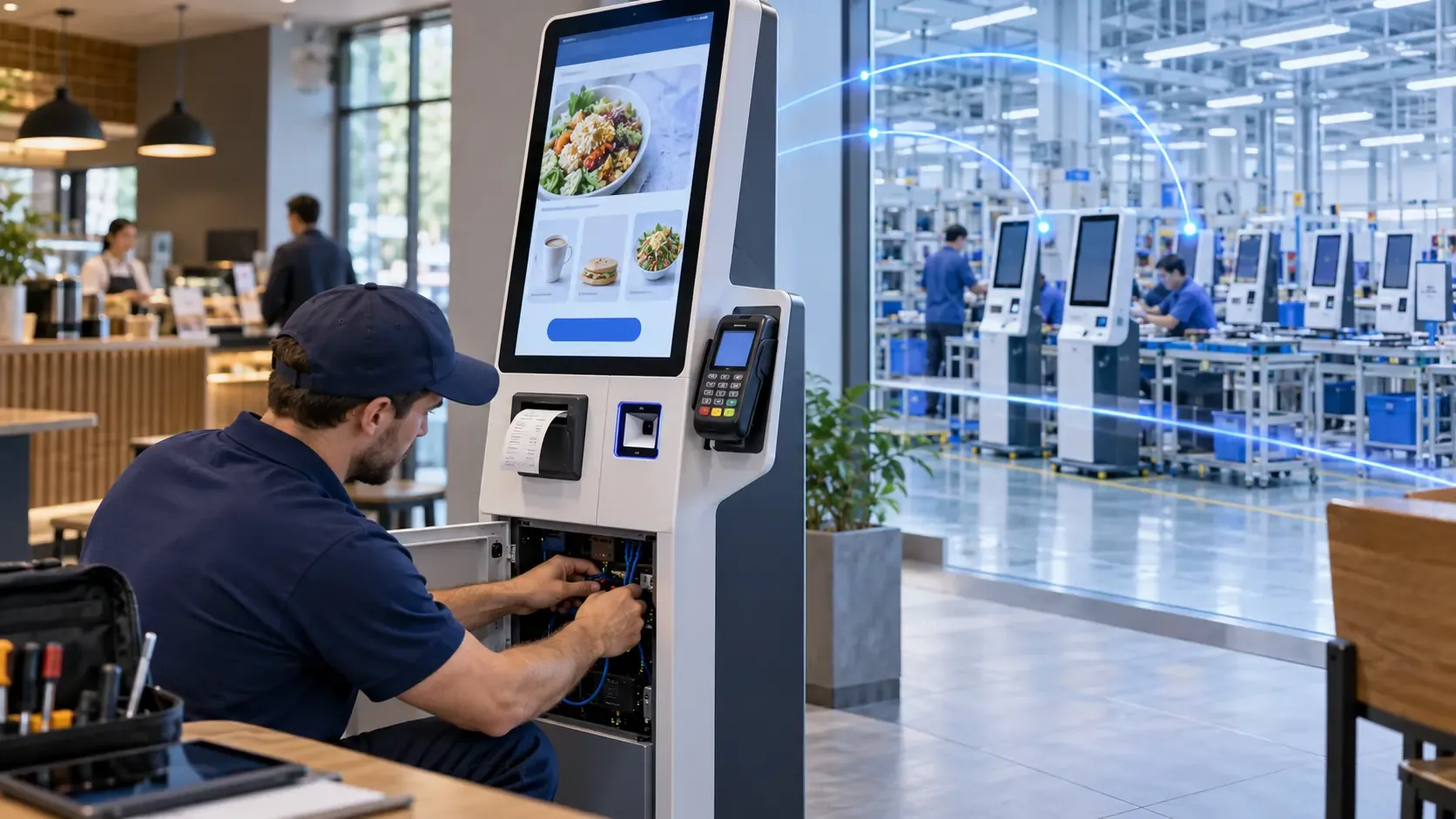
North America is not short on software. It is short on the local industrial ecosystem required to turn software into affordable, dependable physical systems.
That distinction helps explain why self-service technology often feels more embedded in everyday life in China. Ordering, check-in, ticketing, access control and payment can be built into the physical environment at a scale that is still uneven across Canada and the United States.
The gap is not caused by one missing app. A kiosk is not merely a website placed on a touchscreen. It is a combination of hardware, enclosure design, payment infrastructure, peripherals, networking, software and field support. China has a dense manufacturing base capable of producing and revising those components quickly. North America has strong software and payment platforms, but far less local capacity for producing complete kiosk systems economically.
That leaves an important role for systems integrators: connecting global hardware supply chains to the needs of local businesses.
A kiosk is a manufactured system, not just a screen
A basic digital display can be deployed almost anywhere. A useful business kiosk is more demanding.
Depending on the workflow, it may require:
- A commercial touchscreen and enclosure
- A computer, operating system and remote-management tools
- A payment terminal and processor integration
- A barcode or QR-code scanner
- A receipt or ticket printer
- A camera, microphone or accessibility hardware
- Stable Wi-Fi or wired networking
- Secure mounting, cable routing and power management
- Software connected to the business’s booking, inventory or customer records
Every added component introduces another physical and technical dependency. The monitor must fit the enclosure. The printer needs ventilation, paper access and a compatible driver. The scanner must read reliably through the kiosk opening. The payment terminal must be positioned securely while remaining usable and compliant.
This is where the difference between software development and systems integration becomes clear. Software may define the workflow, but the complete result has to function in a real commercial environment.
China’s advantage is the surrounding factory ecosystem
China’s strength in physical automation is not limited to inexpensive labour or one category of finished product. Its advantage comes from manufacturing density.
Within the same industrial ecosystem, a supplier can source touchscreens, metal enclosures, embedded computers, cables, printers, scanners, cameras, mounting hardware and custom-cut components. If a design needs to change, nearby suppliers can often modify a bracket, opening, wiring harness or enclosure without rebuilding the entire supply chain.
This matters because physical products improve through repeated testing. A prototype reveals that a printer door is difficult to service, a scanner angle is unreliable or a screen generates too much heat. When manufacturers and component suppliers are concentrated geographically, those problems can be corrected faster and at lower cost.
The scale of this ecosystem is visible beyond kiosks. The International Federation of Robotics reports that China has become the world’s largest market for industrial robots, reflecting the breadth of its manufacturing and automation capacity. The broader lesson is not that a kiosk and an industrial robot are the same product. It is that automation becomes easier to deploy when factories, components, technical labour and suppliers already exist around it.
North America retains major strengths in software, cloud infrastructure, payments and enterprise technology. What it often lacks is an equally accessible local network for low-volume physical product development.
Why importing a kiosk does not finish the job
It is easy to browse a catalogue and assume the problem has been solved. A factory can sell a kiosk enclosure or a complete-looking unit, but the equipment still has to be adapted to the buyer’s actual operation.
A local business may need the kiosk to:
- Check customers into scheduled appointments
- Take deposits or full payments
- Print a queue ticket or receipt
- Scan a booking confirmation
- Apply business-specific rules and pricing
- Notify staff when assistance is needed
- Continue operating when one external service is temporarily unavailable
- Meet local accessibility, electrical and payment requirements
The overseas manufacturer usually does not own that complete workflow. The software vendor may understand the application but not the enclosure, peripherals or on-site network. The payment provider supplies the terminal but not the rest of the system. A general IT provider may support computers and Wi-Fi without building customer-facing automation.
Someone must take responsibility for how all of these pieces work together.
Systems integrators bridge the physical automation gap
Systems integrators fill the space between a hardware supplier and the business using the equipment.
Their role can include:
- Mapping the customer journey and deciding what should be automated
- Selecting compatible kiosk hardware and peripherals
- Developing or connecting the software workflow
- Integrating payments, printers, scanners and business systems
- Configuring the device, network and remote management
- Testing the complete system before deployment
- Installing, maintaining and repairing it locally
This model allows North American businesses to benefit from global manufacturing without pretending that imported hardware is plug-and-play.
It also creates room for local customization. A small clinic, vehicle service business, rental operator or multi-location retailer does not necessarily need a mass-produced platform designed for thousands of identical locations. It may need a focused workflow designed around its existing staff, payment process and customer volume.
The integrator can source standardized components where standardization makes sense, then add the local software, configuration, fabrication and service layer that makes the equipment useful.
The opportunity is not to recreate every factory locally
North America does not need to manufacture every touchscreen, mini PC or receipt printer domestically before it can adopt more physical automation.
A practical model is hybrid:
- Source proven commodity hardware from established global manufacturers
- Use modular components that can be replaced independently
- Perform final configuration, testing and quality control locally
- Use local fabrication for brackets, panels and enclosure modifications
- Build integrations around North American payment and business platforms
- Keep replacement parts and service expertise close to the customer
This approach reduces dependence on a single proprietary machine. If the computer, display or scanner can be replaced without discarding the complete kiosk, the system becomes easier to maintain and upgrade.
It also creates skilled local work. Hardware sourcing may remain global, but workflow design, software development, network configuration, installation, repair and client support are inherently local services.
Better kiosk adoption starts with smaller, useful deployments
Many businesses do not need a futuristic store with every task automated. They need one bottleneck removed.
A first deployment might automate appointment check-in, allow customers to pay an outstanding balance or print a pickup ticket. Staff remain available for exceptions, while repetitive intake work moves to the kiosk.
That smaller starting point matters. It limits risk, produces real operating data and gives the business time to see how customers respond. Once the workflow is stable, the same platform can expand to additional services or locations.
Physical automation succeeds when it is treated as an operating system for a real business process—not as a piece of decorative technology.
North America’s kiosk gap is an integration opportunity
China’s manufacturing base gives it a structural advantage in physical automation. Components are easier to source, products are faster to customize and the surrounding supply chain supports repeated hardware iteration.
Canada and the United States cannot close that gap with software alone. But they do not have to wait for a complete domestic manufacturing revival either.
Systems integrators can bridge the present-day gap by combining globally sourced equipment with local software, payments, networking, fabrication and field service. That is how a catalogue product becomes a reliable business system.
As labour costs rise and businesses look for more efficient ways to serve customers, the demand will not be for kiosks in isolation. It will be for people and companies capable of making physical automation work from end to end.
Fieldzora designs and integrates kiosk systems for brick-and-mortar businesses in Toronto and the GTA. We connect kiosk hardware with custom software, payment terminals, scanners, printers and local IT infrastructure. Contact Fieldzora to discuss a self-service workflow for your business.